
Lung cancer ranks first among malignant tumors in China, and its incidence and mortality remain far ahead of other cancer types.
— National Cancer Center, "Analysis of the Cancer Epidemiology in China, 2016"
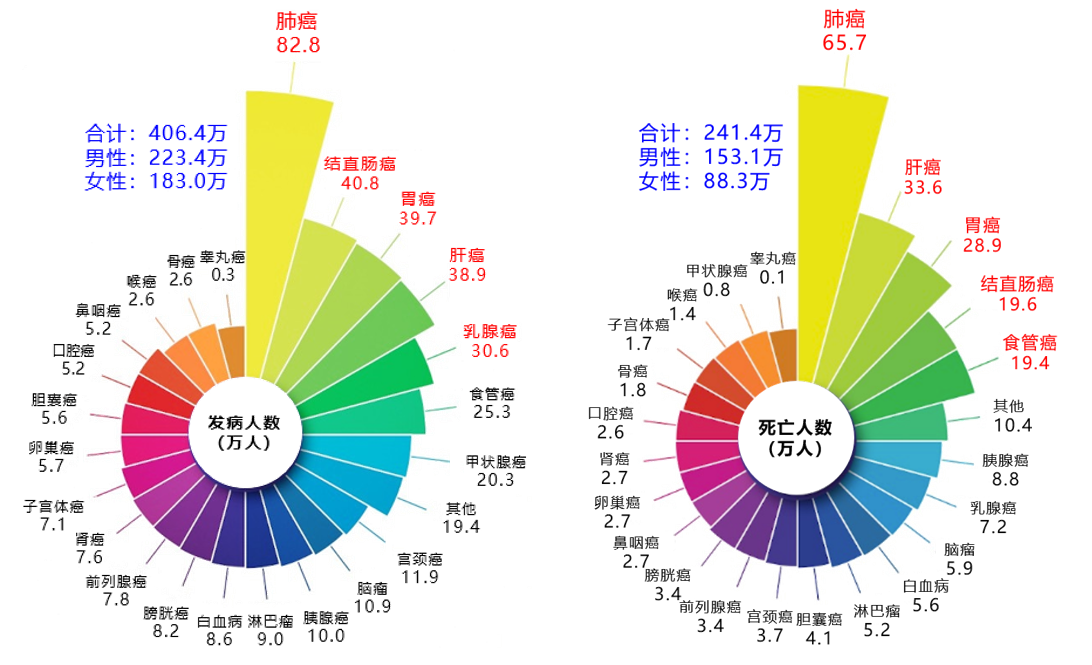
Lung cancer incidence and deaths in 2016 (in tens of thousands)
Lung cancer is affecting younger patients
Lung cancer has very high incidence and mortality rates, both rising year by year, and it is increasingly affecting younger people. In the past, the high-risk group was aged 65 to 70 and above, making lung cancer a "disease of old age." Today in China, however, 75% of lung cancer patients are between 45 and 65 years old, and the average age at onset drops by one year every five years. Patients in their forties and fifties are far more common than before, and patients under 40 are no longer unusual.
Why is lung cancer usually diagnosed at a late stage?
Around 70–80% of patients are already at an advanced stage when they seek care, mainly for the following reasons:
Lung cancer has an insidious onset and its early symptoms are atypical. Because the lung itself has no pain receptors and most tumors grow outside the airways, early-stage lung cancer causes no pain and does not trigger coughing. By the time symptoms appear—cough, blood-streaked sputum or hemoptysis, wheezing, chest pain, hoarseness or fever—the disease has usually reached an advanced stage.
Most lung cancers cannot be detected through blood tests, while chest X-rays offer low resolution and a high miss rate. Regular health check-ups are not yet widespread in China, and early symptoms are easily confused with those of conditions such as pulmonary nodules, so the early detection rate remains low.
Prevention first: lung cancer need not be feared
The five-year survival rate (the proportion of patients surviving more than five years after treatment) for early-stage lung cancer reaches 80%, while survival at the middle and late stages is extremely low. Early detection, early diagnosis and early treatment are therefore crucial.
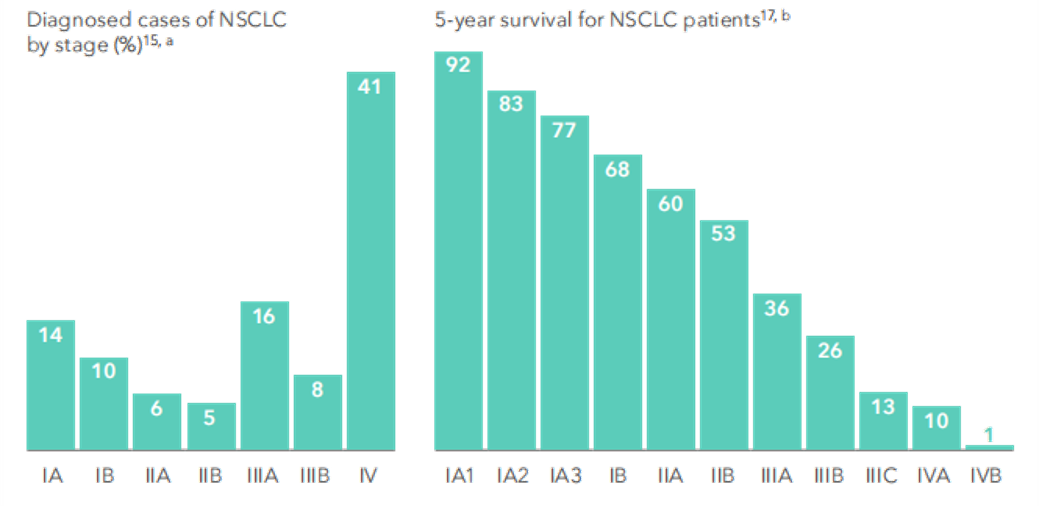
Diagnostic stage and five-year survival rate of non-small cell lung cancer (NSCLC)
The National Lung Screening Trial (NSLT) showed that among people at high risk of lung cancer, screening with low-dose computed tomography (LDCT) reduced mortality risk by 20% compared with conventional chest X-ray. It is the "gold standard" for early lung cancer screening and has been included in major lung cancer prevention guidelines worldwide as the screening modality for high-risk populations. The Chinese Guideline for Low-Dose Spiral CT Lung Cancer Screening (2018 edition) recommends annual LDCT screening for people at high risk.
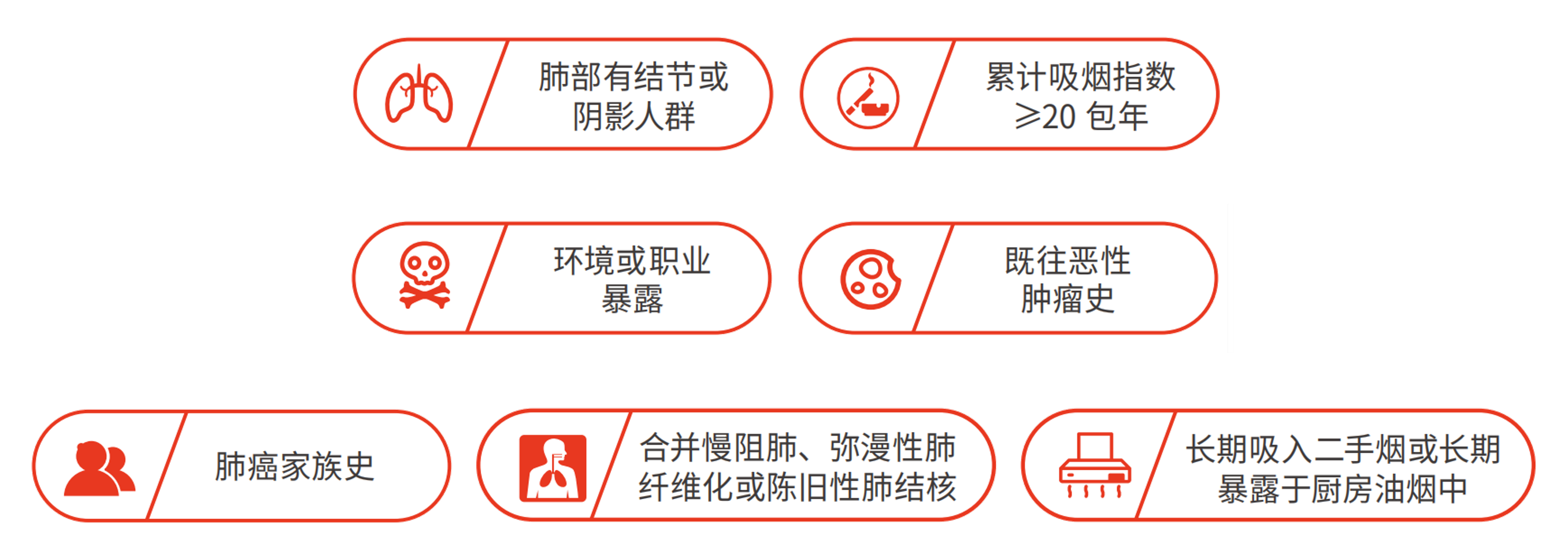
Populations at high risk of lung cancer
Monitoring recurrence to extend survival
Multiple statistical reports show that roughly 20% of lung cancer patients are diagnosed at stage I, where treatment centers on surgical resection followed by surveillance without adjuvant therapy. Even so, about 30% of patients experience recurrence within five years after resection, and recurrence is usually disseminated and systemic, sharply increasing both malignancy and mortality.
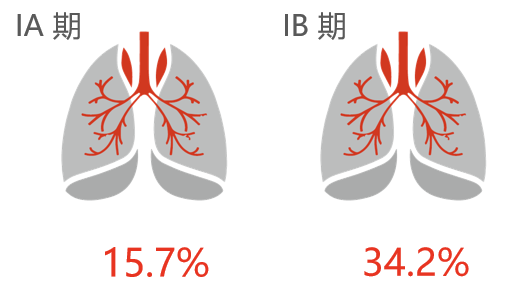
Five-year recurrence rates of stage IA and IB lung cancer
Finding clinical tests that can predict the risk of recurrence in stage I lung cancer as early and as accurately as possible is therefore both a bottleneck and a priority in the clinical management of stage I disease.
As a leader in clinical proteomics, ProteinT provides solutions that address the clinical pain points of lung cancer diagnosis and treatment.
ProteinT non-invasive lung cancer risk screening: PT-ESLCTM
PT-ESLCTM is a non-invasive, convenient and efficient lung cancer risk prediction product. Based on a lung cancer risk screening model developed independently by ProteinT, it calculates a lung cancer risk score and assesses an individual's risk of developing lung cancer. Requiring only 2 mL of blood, it provides accurate early warning of lung cancer risk, with sensitivity of 86% and specificity as high as 93%. It offers a one-stop answer to several clinical pain points in lung cancer diagnosis: the high false-positive rate of LDCT screening, the difficulty of judging whether small nodules are benign or malignant, the risks of needle biopsy, and the subjectivity involved in interpreting diagnostic results.
The product uses liquid chromatography–tandem mass spectrometry (LC-MS/MS) to perform whole-proteome profiling of blood samples from individuals at high risk of lung cancer. Its development rests on ProteinT's core proprietary technology for enriching low-abundance plasma proteins, and the corresponding plasma protein and peptide extraction or purification reagents have been approved (registration No.: Jin Xie Bei 20230397).
ProteinT postoperative recurrence risk prediction for stage I lung cancer: PT-L1TM
PT-L1TM calculates a recurrence risk score for each patient using a stage I lung cancer recurrence risk model developed independently by ProteinT, assessing the patient's risk of recurrence within five years after surgery. Using liquid chromatography–tandem mass spectrometry (LC-MS/MS) for proteomic profiling of patient tumor tissue, it predicts five-year disease-free survival rates of 98.8%, 64.3% and 13.3% for patients at low, intermediate and high recurrence risk respectively, with a negative predictive value (NPV) as high as 98.75%.
For patients at high risk of recurrence, follow-up and re-examination should be made more frequent, with appropriate intervention, so that recurrence can be detected and treated early, survival is prolonged and treatment delay avoided.
For patients at low risk of recurrence, routine follow-up suffices, lowering screening costs and easing both the psychological pressure and the financial burden on patients. The product provides clinicians and patients with a basis for designing more personalized screening plans and interventions.
