
In December 2024, Academician He Fuchu, a pioneer of the international proteomics field at the National Center for Protein Sciences, together with Professor Ruedi Aebersold of ETH Zurich, a leading figure in proteomics, and nearly a hundred international scientists, published an important expert perspective in Nature entitled "π-HuB: the proteomic navigator of the human body." The article elaborates on π-HuB, a major international collaborative initiative, the Human Proteome Navigation Project. Its core goals are to advance disease risk assessment and diagnosis, identify new drug targets, optimize treatment strategies and realize intelligent healthcare, and it sets out key directions for proteomics research over the next decade—for example, precision medicine studies of tissue and body fluid (such as plasma) proteomics across nearly 50 diseases in 10 organs.
Aging of the organism is the combined manifestation of aging at the cellular, tissue and organ levels, and is an important risk factor for chronic disease. Body fluid proteomics reflects the overall state of the organism and offers a powerful tool for studying the mechanisms of aging. Next, through a selection of articles, we take a closer look at how body fluid proteomics contributes to aging research.
01▕ Plasma proteins vs. organ aging and disease prediction
Article:Organ aging signatures in the plasma proteome track health and disease
Journal:Nature
Impact factor:64.8
Summary:
The researchers measured 4,979 plasma proteins in 5,676 adults across five independent cohorts and constructed a population plasma proteomics atlas. Using machine learning, they built aging models for 11 major organs, exploring how the plasma proteome indicates the aging process of individual organs and predicts disease and aging effects.

Plasma proteomics vs. organ aging
02▕ Aqueous humor / vitreous humor vs. cellular aging
Article:Liquid-biopsy proteomics combined with AI identifies cellular drivers of eye aging and disease in vivo
Journal:Cell
Impact factor:64.5
Summary:
The researchers performed proteomic analysis of aqueous humor and vitreous humor from 120 healthy individuals and patients and, by integrating single-cell transcriptomics from all known eye cell types, traced the cellular origin of the 5,953 proteins detected and identified hundreds of cell-specific protein markers. The researchers also developed an artificial intelligence (AI) model to assess the aging of individual cells, which can accurately estimate the molecular age of the eye and can also be applied to reveal disease-specific, age-independent pathways of accelerated cellular aging.

The TEMPO model reveals aqueous/vitreous humor vs. cellular aging
03▕ Plasma proteomics vs. chronic disease
Article:Proteomic aging clock predicts mortality and risk of common age-related diseases in diverse populations
Journal:Nature Medicine
Impact factor:58.7
Summary:
This study integrated protein expression data and clinical data from the UK Biobank, China Kadoorie Biobank and FinnGen cohorts. Using proteomic data covering 2,897 plasma proteins in the UK Biobank and machine learning models such as LightGBM, the researchers developed a protein age prediction model and examined its role in predicting the incidence of major diseases and mortality across different populations. They identified 204 proteins that accurately predict chronological age, and found that the proteomic aging score is associated with the onset of 18 major chronic diseases (including heart, liver, kidney and lung disease, diabetes, neurodegenerative disease and cancer), with multimorbidity, and with all-cause mortality risk.
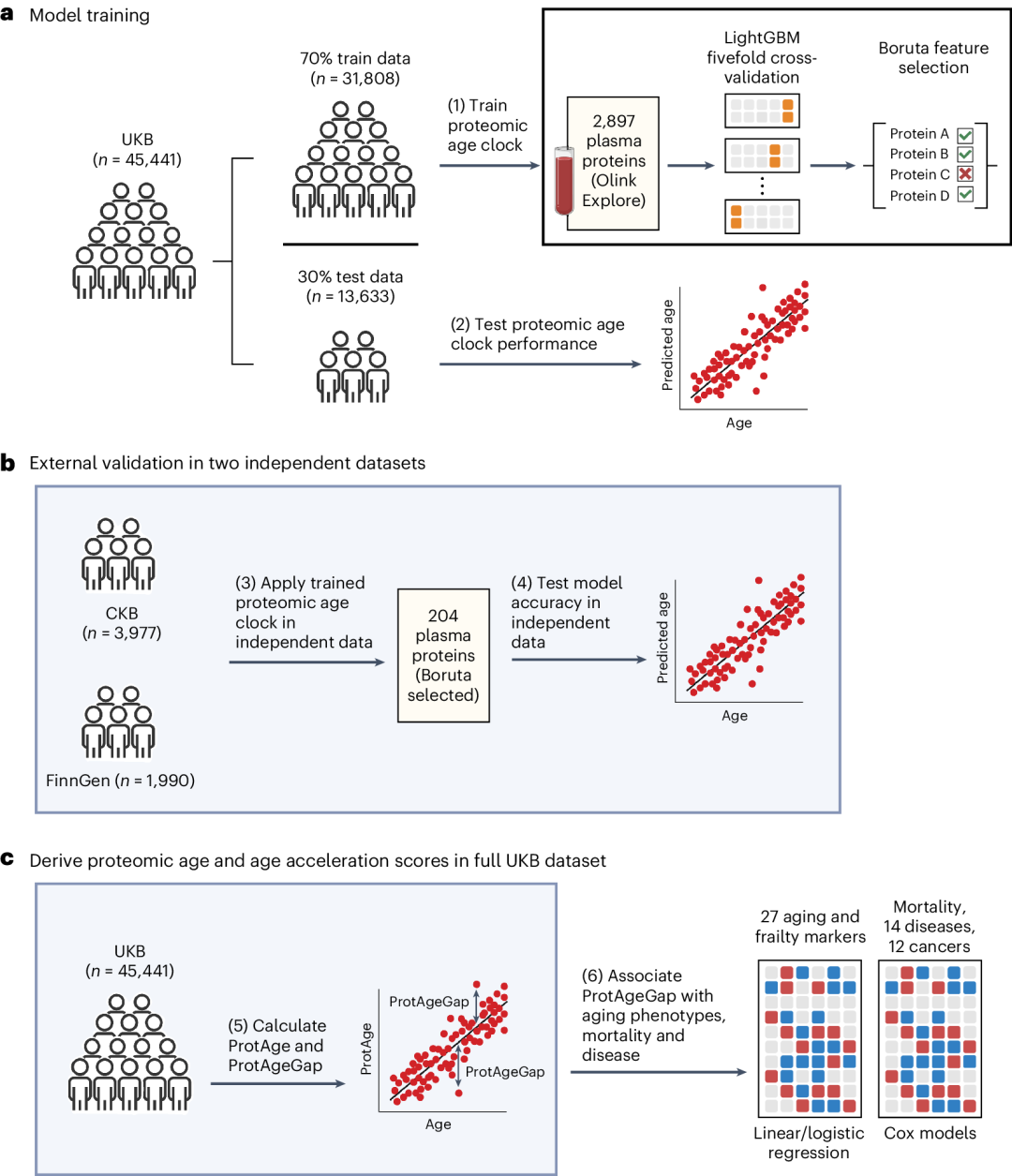
Overview of the study design and analytical approach
04▕ Plasma proteomics vs. brain aging
Article:Plasma proteomics identify biomarkers and undulating changes of brain aging
Journal:Nature Aging
Impact factor:17
Summary:
The study used machine learning models and multimodal magnetic resonance imaging-based brain data to estimate the brain age gap (BAG) in 10,949 healthy participants from the UK Biobank. Among 1,705 imaging-derived phenotypes (IDPs), the team selected 864 IDPs related to brain age for a proteome-wide association study of contributors to BAG. Based on a plasma proteomic profile of 2,922 proteins in 4,696 participants, the researchers identified 13 plasma proteins significantly associated with BAG, which in turn showed significant associations with brain traits or diseases.
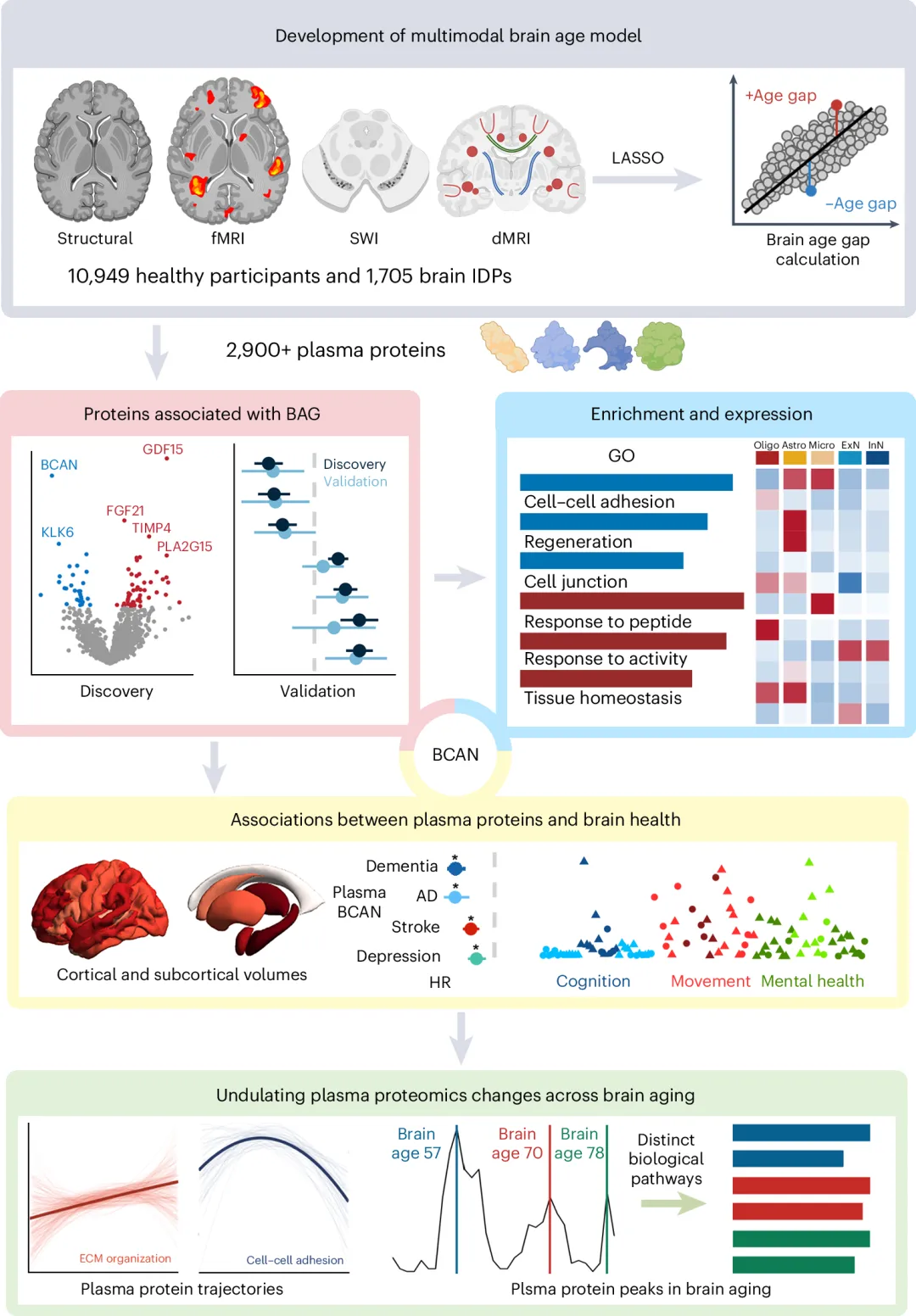
Overview of the study design and analytical approach
Through the articles above, we can appreciate the tremendous potential of body fluid proteomics in aging research. This technology can map the expression profile of body fluid proteins with precision and depth; combined with machine learning it can dig deeper into the relationship between body fluid proteins and aging, discover the protein molecular clocks of cellular, tissue and organ aging, dissect the molecular mechanisms of aging, and uncover markers of aging-related chronic disease—providing a powerful tool and an effective solution for understanding the aging process.
