With the continuous advance of nanomaterial enrichment technologies and the steady improvement of mass spectrometry detection sensitivity, mass spectrometry-based plasma proteomics has become a widely followed technical route, markedly increasing both the depth and the sensitivity of plasma protein detection. This progress, however, has also brought the problem of insufficient stability in plasma protein detection into sharper focus. To address this challenge, a leading group in the field of proteomics — the Mann group and colleagues — systematically analysed the causes of unstable plasma protein detection and proposed solutions of practical value, laying a more reliable theoretical foundation for the clinical translation of plasma proteomics.

Systematic Analysis of the Impact of Cellular Contamination on Plasma Proteomics Workflows
Direct Causes
· Platelet contamination:specific proteins released by platelets (such as PF4V1 and PPBP) significantly increase the number of proteins identified, an effect that is particularly pronounced in magnetic bead enrichment methods.
· Red blood cell contamination:haemoglobin and its degradation products (such as HBA1 and HBB) interfere with the detection of low-abundance proteins, leading to false-positive results.
· PBMC contamination:proteins released by peripheral blood mononuclear cells (such as lymphocytes and monocytes) inflate apparent detection depth and mask the true biological signal.
· Plasma–serum mixed state:improper handling leads to incomplete coagulation and produces a mixed-state sample, affecting the quantitative results of proteomics.

A Systematic Experimental Framework for Comparing Plasma Proteomics Workflows
Influencing Factors
· Type of blood collection tube:the type of anticoagulant and the material of the tube directly affect test results. For example, the anticoagulant EDTA may induce platelet activation, and tubes made of different materials may also affect protein adsorption efficiency and cell stability.
· Centrifugation conditions:low-speed centrifugation (such as 500 g) cannot fully remove blood cells, whereas high-speed centrifugation (such as 3,000 g for 30 minutes) can markedly reduce cellular contamination.
· Sample collection and storage:non-standardized collection procedures may lead to incomplete coagulation and a plasma–serum mixed state, compromising protein quantification; at the same time, improper storage (such as repeated freeze–thaw cycles) can also cause abnormalities in the protein profile.
Solutions
· Standardizing centrifugation conditions:centrifugation at 3,000 g for 30 minutes is recommended to remove blood cells thoroughly.
· Standardizing collection tubes:use the same type of collection tube throughout (EDTA tubes, for example) to reduce batch effects arising from matrix differences.
· Standardizing the blood collection procedure:control the interval between blood collection and plasma separation to avoid shifts in the protein profile caused by differences in coagulation state.
· Contamination assessment mechanism:assess contamination on the basis of the expression of proteins detected in the sample, and remove abnormal samples.
The ProteinT Approach | Strategies for Optimizing Stability Across Multiple Sample Types
The instability of plasma proteomics results stems mainly from blood cell contamination and from variable interference in the sample handling workflow. Standardizing the sample collection process and establishing a systematic contamination assessment mechanism can markedly improve detection sensitivity and data stability.As an early explorer in the field of body fluid proteomics, ProteinT has built a distinctive and practically valuable set of solutions to address these challenges effectively.
Plasma Samples
· Plasma samples already collected:an independently developed plasma-based quality control system screens out substandard samples at the QC stage, significantly improving data consistency and the stability of detection results.

· Plasma samples not yet collected:independently developed and registered plasma collection tubes improve the stability of blood samples at source, reducing the interference that collection and processing procedures introduce into proteomic results.

Non-Plasma Samples
· Serum samples:enrichment materials and mass spectrometry parameters have been optimized to improve the detection of low-abundance proteins, effectively resolving the difficulty of detecting only a small number of proteins in serum.

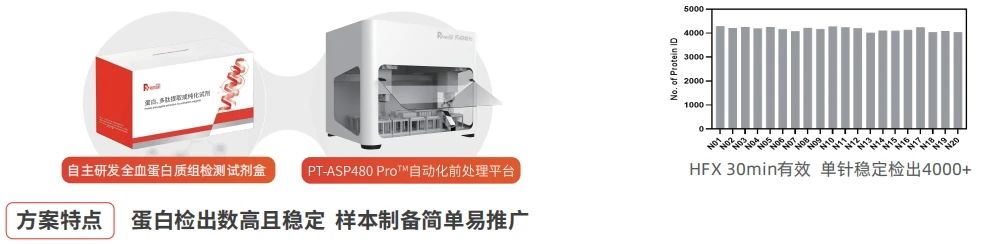
· Whole blood samples:innovative contamination-resistant enrichment materials have been developed that support direct processing of frozen whole blood, delivering an end-to-end whole-blood proteomics solution that simplifies sample collection and avoids the uncontrollable contamination introduced by intermediate steps such as plasma separation.