
Precision medicine is a medical model that integrates multidimensional information—individual genetic variation, environmental factors and lifestyle—to tailor diagnostic, therapeutic and preventive strategies to each patient. Driven by rapid advances in frontier technologies and the deepening of multi-omics research, the field is undergoing a profound transition from being "gene-centered" to being "protein-centered." Since the concept of Proteomics-Driven Precision Medicine (PDPM) was proposed in 20191, it has become a key force in upgrading the research paradigm of precision medicine. Compared with the relatively stable genome, the proteome is far more complex and dynamic. It reflects the actual execution state of life processes and correlates closely with disease onset, progression and treatment response, giving it irreplaceable value in deciphering disease mechanisms and guiding precise intervention.
On July 14, 2025, the team of Academician He Fuchu at the State Key Laboratory of Medical Proteomics published a review online in National Science Review entitled The coming era of proteomics-driven precision medicine2. The article systematically reviews key advances in proteomics for precision medicine, focusing on high-precision mapping of the human protein expression profile, in-depth analysis of post-translational modifications, systematic construction of protein interaction networks, and frontier exploration in spatial proteomics. These technological breakthroughs have deepened our understanding of disease, advanced precise diagnostic approaches, and provided a solid foundation for individualized treatment strategies. On this basis, the authors state clearly that "the era of proteomics-driven precision medicine has arrived." If genomics-driven precision medicine is regarded as the first generation of precision medicine, then proteomics-driven precision medicine is the second generation—and at the same time, the first generation of intelligent medicine.
01 The Emergence and Evolution of Disease Classification Systems
The vigorous development of precision medicine is deeply rooted in the continuing evolution of disease classification systems, progress of immeasurable value for standardizing the classification of diseases and health conditions. Authoritative systems such as the International Classification of Diseases (ICD) promoted by the World Health Organization (WHO) have laid a solid foundation for establishing diagnostic criteria and guiding health management practice. Yet in the face of growing demand for individualized care, these systems often prove too generic to meet each patient's unique needs. Against this backdrop, ontology-based mechanistic disease classification systems have emerged. By skillfully integrating rich clinical data with broad scientific research, such systems aim to dissect and precisely define disease endophenotypes, that is, the specific biological features a disease displays at the individual level3. This innovation greatly raises the level of personalization in medical services, allowing them to match each patient's condition more precisely, and aligns closely with the core philosophy of precision medicine; together they are pushing health care toward more refined, individualized treatment strategies. The development of ontology-based disease classification mechanisms is therefore an important milestone in health care's transition to the era of individualized medicine.
With the rise of genomics and molecular biology, the importance of decoding individual genetic profiles has become increasingly prominent, greatly advancing precision medicine. Genome-driven precision medicine (GDPM) has achieved remarkable results in hereditary diseases and oncology. Recent studies, however, including those based on the UK Biobank, indicate that the genetic contribution to many diseases may be lower than expected, with certain cancers in particular showing limited genetic determinism, which constrains the direct benefit of genomics in cancer targeted therapy4. These findings have prompted us to re-examine the full picture of disease causation and actively explore pathogenic mechanisms beyond genetic factors, seeking new breakthroughs in improving treatment outcomes. In this process, the intricate interplay between genetic and environmental factors has become a focus of attention. Although the genetic makeup provides the basic blueprint of life, it interweaves with environmental influences to jointly shape an individual's health status5. This interaction involves not only genomic variation but also profoundly affects dynamic changes at multiple levels, including the transcriptome and the proteome.
As the direct executors of genetic information, proteins play a central role in life activities. Proteomics, the large-scale systematic study of proteins, is devoted to deciphering their expression patterns, functional properties, and functional differences between healthy and diseased states. Because protein and mRNA levels often diverge owing to factors such as post-translational modifications, proteomics provides a crucial perspective for understanding these complex differences (Figure 1).
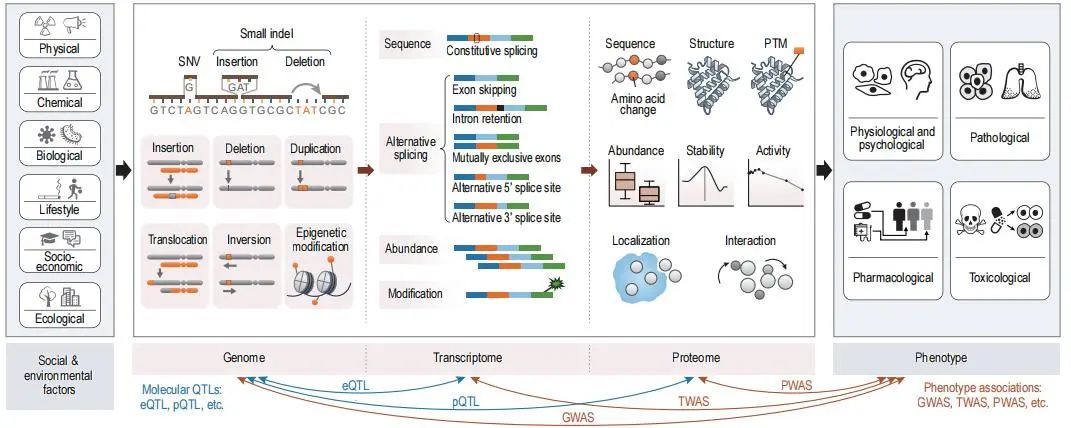
Figure 1. The central role of the proteome in phenotype. The interaction between genetic and environmental factors defines the state of the transcriptome, proteome, metabolome and beyond, among which the proteome directly influences health and disease. The proteome comprises all proteins with their diverse sequences, structures, modifications, abundances, stabilities, activities, localizations and interactions. The phenotypes shown here include physiological, psychological, pathological, pharmacological and toxicological traits. pQTL can detect genetic variants that cause variation in protein expression. PWAS can decipher the proteins that give rise to disease and non-disease phenotypes. SNV, single nucleotide variant. Indel, insertion and deletion. PTM, post-translational modification. QTL, quantitative trait locus. eQTL, expression quantitative trait locus. pQTL, protein quantitative trait locus. GWAS, genome-wide association study. TWAS, transcriptome-wide association study. PWAS, proteome-wide association study.
Over the past fifteen years, global proteomics research has expanded remarkably, a trajectory vividly illustrated by the surge in publications between 2009 and 2023 and reflecting the field's rising importance in the scientific arena. Although genomics has long dominated precision medicine, since 2019 proteomics has rapidly come to the fore, particularly through its deep integration with precision medicine, where its role has become increasingly prominent. Proteomics is closely connected with many frontier areas—fine mapping of the proteome, complex regulation by post-translational modifications, in-depth analysis of protein–protein interactions and spatial proteomics—together forming a multidimensional, multi-level research framework (Figure 2). These advances not only mark proteomics as progressively establishing itself as the core engine of precision medicine, but also herald its enormous potential and far-reaching influence in transforming health care. As technology continues to advance and research deepens, proteomics will undoubtedly become a major force driving precision medicine in the years ahead.
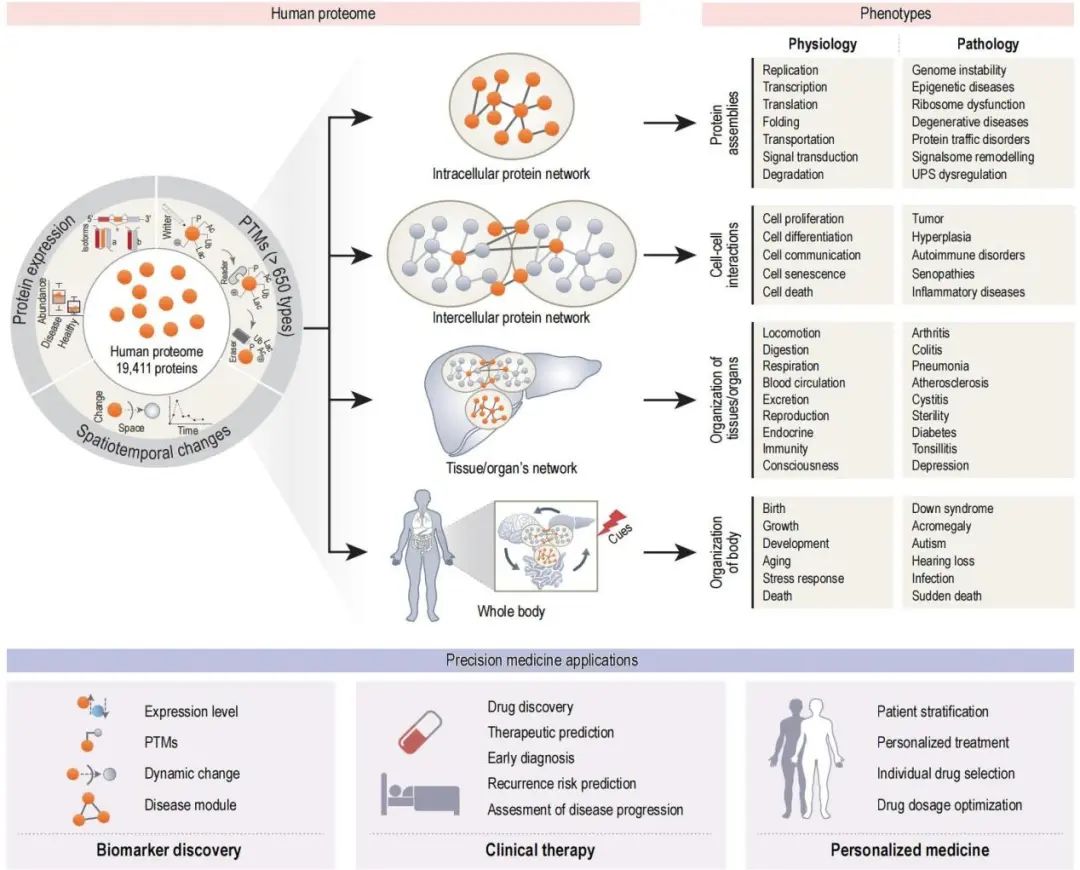
Figure 2. From the human proteome to precision medicine: from molecular features to individualized health outcomes. Protein expression and its post-translational modifications are dynamic across diverse spatiotemporal conditions, ultimately leading to changes in protein–protein interaction networks. These interactions occur at multiple biological levels—intracellular, intercellular, tissue/organ and even organismal—propagating across levels to jointly determine the formation of physiological or pathological phenotypes. P: phosphorylation; Ac: acetylation; Ub: ubiquitination; Lac: lactylation.
02 Technological Leaps Drive Proteomics Research Forward
The core technology system of proteomic medicine is deeply influenced by the "CAP standard" of big science advocated by Nobel laureate Sydney Brenner, a gold standard that combines comprehensiveness, accuracy and permanence6. In proteomics, following the CAP standard means not only conducting exhaustive, in-depth analysis and fine-grained interpretation of protein sequences and their complex functions, but also achieving quantitative capture of their dynamic changes across precise spatial and temporal dimensions. It also requires that the data, insights and principles distilled from proteomics research retain their scientific value and application relevance over time, laying a firm foundation for medical progress. Clinical proteomics still has to overcome a series of complex challenges. The diversity of sample types is particularly prominent, including frozen tissues, formalin-fixed paraffin-embedded sections and various body fluids, whose differences place higher demands on sampling strategy. In addition, the wide dynamic range of protein abundance in body fluids requires detection technologies of extremely high sensitivity to capture low-abundance yet critical proteins. For multicenter collaboration and large-scale cohort studies, the development and application of high-throughput proteomic technologies are essential to improve research efficiency and data output. And for massive proteomic datasets, developing precise and powerful data mining and analysis methods is the only way to unlock their deeper value and drive scientific discovery. Despite these many challenges, researchers in proteomic medicine, through unremitting effort and innovation, have achieved remarkable results and opened new paths for precision medicine and for optimizing disease diagnosis and treatment strategies.
Protein expression profiling: Over the past three decades, proteomics has undergone unprecedented revolutionary breakthroughs in both hardware and software—milestone advances spanning refined sample preparation, efficient peptide separation, leaps in mass spectrometry sequencing, deep data interpretation, and the application of big data and deep learning—that together have driven substantial progress in protein identification and quantification. Specifically, innovations such as pressure cycling technology and single-pot solid-phase-enhanced sample preparation have enabled high-throughput, automated sample processing, greatly improving experimental efficiency and data quality. Meanwhile, multidimensional fractionation, an innovative replacement for conventional gel electrophoresis, has significantly broadened and deepened proteome coverage, providing strong support for comprehensively resolving the proteome composition of living organisms. In quantitative analysis, although high-end technologies such as iTRAQ and TMT face challenges from high cost and slight deviations in quantitative accuracy, they have undoubtedly provided powerful tools for stable quantification and pushed the field toward higher precision. Moreover, the rise of label-free quantification and data-independent acquisition strategies, combined with continued breakthroughs in high-speed, high-resolution mass spectrometry hardware, has jointly improved the throughput, coverage and reproducibility of proteomic analysis. Propelled by these advances, researchers have successfully charted proteome-wide maps of a series of model organisms—maps that reveal the complexity and dynamics of protein composition in vivo and offer valuable resources and insights for deciphering disease mechanisms and discovering drug targets.
Post-translational modifications: Protein post-translational modifications (PTMs) generally refer to the addition of chemical groups to amino acid side chains, endowing proteins with additional regulatory mechanisms or biological functions; common PTMs include phosphorylation, acetylation, ubiquitination and glycosylation. The concept of a modification code is gradually becoming scientific consensus. This code system typically comprises writers (which add PTMs), erasers (which remove PTMs) and readers (which recognize PTMs), regulating protein function—including activity, localization, interaction and degradation. With technological advances, PTM-omics has progressively become an important approach and research strategy for decoding this code. Deep exploration of PTM-omics-based decoding mechanisms has greatly advanced our understanding of disease biology and opened a new era for drug discovery. To date, more than 650 PTMs have been identified, underscoring the indispensable role of modification-omics in sustaining and accelerating the discovery and functional characterization of novel PTMs. Investigating disease mechanisms from the perspective of PTM regulation opens new avenues for precision medicine and targeted drug creation. Furthermore, the rapid evolution of PTM-omics technologies and their deep integration with genomics, transcriptomics and other omics fields are propelling this scientific domain forward with unprecedented force. Such cross-disciplinary integration not only deepens our understanding of the complexity of living systems, but also greatly enhances our capacity for innovation in disease treatment strategies, foreshadowing major breakthroughs in diagnosis, treatment and prevention.
Protein interaction networks (protein linkage map): Emergence refers to the phenomenon whereby a complex whole exhibits properties or behaviors absent from its individual components, properties that manifest only through collective interaction. Protein–protein interactions form the basis of protein complexes and molecular machines, establishing hierarchical and clustered structures among protein populations and thereby producing emergent properties that no single protein possesses. Notably, the emergent properties of protein–protein interactions exist at multiple levels, extending from the molecular scale to cells, tissues/organs and even the individual organism. Each level of emergent life characteristics represents an extension of properties generated by interactions at the level below. Comprehensive mapping of protein interaction networks at different levels is one of the central tasks of proteomics, helping to reveal emergent phenotypes or features that manifest only through protein collectives. The complete human interactome covers approximately 19,411 protein-coding genes, with estimates of binary protein interactions ranging from 500,000 to 3 million.
Protein interaction networks provide new insight into the emergent properties of the human "protein society" at every level. First, at the intracellular level, studies have uncovered the social architecture and modular structure of protein interaction networks, including modules for DNA replication, RNA transcription, protein translation and protein transport, indicating the presence of highly connected topological modules or communities. Charting a global human protein interactome or reference map is an important cornerstone of molecular and systems biology research. Second, at the intercellular level, studies have systematically mapped interaction networks among human immune cells, providing a systematic view of cell-to-cell network relationships. Third, at the tissue or organ level, the distinctive functions and properties of each organ largely derive from unique interaction networks formed by selective splice variants or tissue-specific proteins.
Abnormal emergent properties of protein social groups can lead to various human diseases. Remodeling or aberrant assembly of protein complexes and molecular machines can trigger pathological emergence and ultimately produce the uncontrolled phenotypes of many human diseases. Comparing normal and mutant assembly patterns of protein complexes can identify novel pathogenic interactions; for example, disease-related alterations in protein interactions have been found in studies of tumors and autism. In addition, pathogens can induce abnormal emergence in the protein society and cause human disease. Multiple studies have systematically analyzed interaction networks between pathogens and human proteins, including SARS-CoV-2 and Ebola virus, providing valuable resources, drug targets and drug candidates for the clinical treatment of infectious diseases.
Spatial proteome (proteome localization map): Given the profound link between the precise localization of proteins at the tissue, cellular and even subcellular levels and their function, spatial proteomics—as a core approach in this domain—provides powerful support for comprehensively resolving protein spatial distribution, interaction mechanisms and functional properties, thereby advancing medical research. In spatial proteomics practice, high-precision sample collection and data analysis strategies occupy a pivotal position. By closely linking proteomic features to their concrete locations within the organism, these strategies bring unprecedented perspectives to clinical medicine. Using frontier approaches such as three-dimensional imaging and mass spectrometry analysis of solvent-cleared organs (DISCO-MS), scientists have identified biomarkers closely associated with atherosclerosis and revealed regional differences in protein distribution within the plaque microenvironment. For the complex molecular heterogeneity of the tumor microenvironment and the inconsistency between mRNA levels and protein abundance, the combination of laser capture microdissection (LCM)-based sampling at micrometer resolution with differential proteomics has proved an efficient and precise approach for comparing molecular features across tumor regions. This strategy has revealed the key role of stromal cells in ovarian cancer and elucidated chemotherapy resistance mechanisms in glioblastoma, underscoring the value of region-specific proteomes in identifying disease drivers and designing targeted therapies.
Although cell-type-resolved and single-cell spatial proteomics face many challenges in pursuing higher sensitivity and resolution, research in this area has made notable progress. The introduction of deep visual proteomics (DVP) has greatly advanced proteomics toward greater depth. This technology can precisely track proteomic changes during the transition from normal cells to invasive melanoma and has revealed key dysregulated pathways in tumor progression. In studies of extracellular matrix dynamics, DVP has shown unique advantages over single-cell transcriptomics. The rise of single-cell DVP (scDVP) has further pushed the precision of spatial proteomics to unprecedented heights, enabling single-cell proteomic analysis without predefined cell-type information and opening new possibilities for life science research.
Proteomics resources: As proteomics continues to evolve, the research paradigm running from data to information, then to knowledge and finally to wisdom has been realized through the analysis and mining of massive datasets in proteomic repositories such as PRIDE and iProX. These data are converted into qualitative and quantitative information by tools such as pFind and MaxQuant. Further, this information is transformed through resources such as dbPTM, BioGRID and the Human Protein Atlas into knowledge of specific biological processes and disease mechanisms. Ultimately, this knowledge guides clinical wisdom, enabling personalized treatment and improving patient outcomes. The "data–information–knowledge–wisdom" paradigm highlights the transformative impact of integrating proteomics resources in achieving intelligent medicine.
03 The Human Proteome Reference Atlas
Progress by the Human Proteome Project (HPP) has significantly deepened our knowledge of the human proteome. According to the latest report, 18,138 (93%) of the 19,411 GENCODE protein-coding genes have now been experimentally validated at the protein level by mass spectrometry–based methods. In parallel, the Human Protein Atlas (HPA) project, integrating high-affinity antibodies with immunoassays, has mapped the proteomes of 32 healthy human tissues and organs and, combined with quantitative transcriptomic data, identified more than 90% of predicted protein-coding genes. Moreover, the research lens has extended to finer levels, moving progressively from whole organs to anatomical regions, individual cells and even organelles, constructing multilayered, multidimensional proteome reference atlases covering healthy adult humans as well as model organisms such as the mouse. These atlases depict not only protein expression patterns and abundances in detail, but also explore diverse protein modification states including phosphorylation, the diversity of protein variants, and complex protein–protein interaction networks.
In living organisms, each organ operates through complex and finely structured hierarchies in which a great variety of cells work in concert to perform specific physiological functions. To dissect how trillions of cells and thousands of cell types cooperate precisely to sustain normal life activities, and to reveal the mechanisms of disease, researchers have applied mass spectrometry–based proteomics to explore different anatomical regions and cell types across several key organs. These pioneering studies have produced detailed cellular and molecular atlases for core organs such as the heart, brain, skin and liver, revealing the deep mechanisms by which cells within an organ divide their labor while cooperating closely. Taking the liver as an example, a cell-type-resolved proteomic study of the healthy adult mouse liver revealed for the first time the principles governing organ (liver) cellular composition and division of labor. The study found that in core hepatic metabolic processes, parenchymal cells (hepatocytes) act as the principal executors, whereas non-parenchymal cells such as liver sinusoidal endothelial cells, Kupffer cells and hepatic stellate cells mainly provide the necessary triggering and modulation through regulatory mechanisms. Crucially, hepatocytes sustain hepatic dynamic equilibrium and homeostasis through a highly complex interaction network involving ligands secreted by non-parenchymal cells, receptors within parenchymal cells, transcription factors and target genes. In neuroscience, moreover, researchers performing synaptic proteomics across different mouse brain regions and cell types identified approximately 1,800 proteins significantly enriched in specific synapse types, discovered 18 key protein modules shared across different synapse types, and pinpointed hub proteins specific to particular synapse types. These findings provide an important molecular basis for understanding the structural diversity and functional complexity of the synapse, the basic functional unit of the nervous system, and its central role in neural information transmission.
04 Applications of the Proteome in Health Monitoring and Disease Surveillance
Health is essentially a state of molecular dynamic equilibrium maintained among the body's systems, extending beyond the single perspective of pathology. The blood proteome, obtainable non-invasively, opens new avenues for personalized health monitoring and tracking. With innovations such as microsampling technologies and wearable devices, it is now possible to collect blood samples hourly over the course of a week and thereby delineate molecular dynamics over time. These fluctuations are closely tied to physiological and pathological activities, illustrating the capacity of proteomics to monitor health status by tracking molecular dynamics in vivo. Through in-depth study of plasma proteins across the human lifespan, proteomics has drawn a panoramic map of change spanning birth, aging, illness and death. Early explorations revealed periodic patterns in protein abundance tied to aging and disease onset—a breakthrough that has deepened the scientific community's insight into aging mechanisms and led to the construction of more than ten aging prediction models. These models cover nine common age-related health challenges: Alzheimer's disease, atrial fibrillation, cerebrovascular disease, diabetes, heart attack, hypercholesterolemia, hypertension, obesity and gait disorders. In sum, the blood proteome atlas is increasingly important as a systematic indicator of human health status. It provides key information for understanding and explaining the patterns of change at every stage of life, and has become a vital tool for predicting, intervening in and optimizing human health, leading innovation in the future of health care.
Proteomics is emerging as a transformative force in disease risk assessment. In a prospective cohort study, researchers built a protein risk score that predicted the risk of atherosclerotic cardiovascular disease and diabetes with accuracy significantly exceeding conventional polygenic risk score models. Particularly striking is that in-depth plasma proteomic analysis revealed glial fibrillary acidic protein (GFAP) levels as a warning signal up to 15 years before dementia onset, illustrating the potential and value of proteomics in ultra-early disease risk assessment. It is worth emphasizing that as proteomic technologies mature, their outputs have gradually gained recognition and adoption by regulatory authorities. The FDA, for example, has approved several protein biomarker–based cancer detection tools, such as OVA1 for effective ovarian cancer risk assessment, the combination of des-gamma-carboxy prothrombin (DCP) and the alpha-fetoprotein isoform AFP-L3 for precise diagnosis of hepatocellular carcinoma, and CancerSEEK, a revolutionary platform capable of screening eight different cancer types. These milestone advances not only demonstrate the outstanding capacity of proteomics to discover novel biomarkers, but also herald substantial improvements in the sensitivity and specificity of existing diagnostic tools, providing solid data support for clinical decision-making.
05 Proteome-Based Personalized Therapy
Over the past decade, medicine has come to appreciate disease heterogeneity ever more deeply, recognizing that even patients diagnosed with the same disease display marked diversity in their intrinsic biology, urgently calling for stratified management and personalized treatment in precision medicine. This understanding has driven the rapid development of omics technologies, proteomics in particular, in molecular subtyping, making it a frontier of precision medicine. Proteomic molecular subtyping, by probing the complex pathological mechanisms of tumors (such as breast, liver, lung, gastric and esophageal cancer), provides the scientific basis for disease classification and treatment decisions. Because proteins are the main carriers of drug targets, proteomic subtyping offers unique advantages: it not only correlates closely with patient prognosis, but also clearly depicts the expression patterns of drug targets across patient subtypes, pointing the way for drug development based on subtype-specific pathways and target proteins. For instance, SOAT1 in hepatocellular carcinoma, NNMT in ovarian cancer and CDK2 in diffuse glioma all suggest that interventions directed at these targets may offer patients more precise and effective treatment options. Drug resistance, a major obstacle on the road to successful treatment, urgently calls for innovative intervention strategies to enhance drug sensitivity or reverse resistance. A proteomic study of 242 patients with high-grade serous ovarian cancer (HGSOC) revealed a link between an active fatty acid oxidation pathway and a chemotherapy-refractory subgroup, suggesting that CPT1A, a key enzyme in this pathway, could become a new target for improving sensitivity to platinum-based chemotherapy.
06 Challenges and Hope
Despite tremendous progress in precision medicine, achieving optimal clinical practice at the individual patient level remains challenging, owing to the complexity of medical specialties, the rapid evolution of technology, and the diversity of diseases and clinical guidelines. These challenges stem mainly from uncertainty in clinical diagnosis, the gap between theory and practice, and possible cognitive biases among clinicians—factors that together make it harder to find the best treatment path. Against this backdrop, the academic community has begun to revisit and emphasize Aristotle's concept of "Phronesis," or practical wisdom, exploring its potential value in coping with clinical uncertainty and applying medical knowledge efficiently. At the same time, the rise of interdisciplinary research has brought revolutionary changes to clinical decision-making, advocating a holistic view of the human body combined with multilevel systems analysis from cell to organ, thereby providing more comprehensive and deeper insight for clinical decisions. Artificial intelligence, especially deep reinforcement learning, has demonstrated outstanding decision-making capabilities in multiple domains and excels at integrating complex medical knowledge. All this indicates that artificial intelligence will play an important role in the future of medicine.
In light of this, we have formally launched the Proteomic Navigator of the Human Body (π-HuB) project, aiming to advance intelligent medicine through three core objectives7. The first is to chart an "anatomical spatial map" of the human proteome using cutting-edge technologies such as single-cell and spatial proteomics, describing in detail the composition of proteins and their interaction networks within each tissue and cell. The second is to define and resolve the "state space" of the human proteome by continuously tracking proteomic changes across an individual's lifespan and their dynamic adjustment under diverse physiological and pathological conditions. Ultimately, the π-HuB project will build an intelligent navigation system that can accurately identify the body's current state, use dynamic models to predict its trajectory, and plan optimal treatment accordingly. The implementation of this project is of great significance for realizing proteomics-driven intelligent medicine.
Link to the original article: https://doi.org/10.1093/nsr/nwaf278
References:
1. Jiang, Y. et al. Proteomics identifies new therapeutic targets of early-stage hepatocellular carcinoma. Nature 567, 257-261 (2019).
2. Jiang, Y. et al. The coming era of proteomics-driven precision medicine. National Science Review, nwaf278. doi:10.1093/nsr/nwaf278
3. Haendel, M. A., Chute, C. G. & Robinson, P. N. Classification, ontology, and precision medicine. N. Engl. J. Med. 379,1452-1462 (2018).
4. Bycroft, C. et al. The UK Biobank resource with deep phenotyping and genomic data. Nature 562, 203-209 (2018).
5. Wu, H., Eckhardt, C. M. & Baccarelli, A. A. Molecular mechanisms of environmental exposures and human disease. Nat. Rev. Genet. 24, 332-344 (2023).
6. Crombie, C., Junio, A. & Fraser, A. The not-so-humble worm. Genome Biol. 5, 301 (2003).
7. He, F. et al. π-HuB: the proteomic navigator of the human body. Nature 636, 322-331 (2024).
