
Observed every September 21, World Alzheimer's Day reminds us of this chronic neurodegenerative disease. As societies age, the social and economic burden of Alzheimer's disease (AD) continues to grow: one new case of dementia is diagnosed every three seconds worldwide, and roughly 60%–80% of them are caused by Alzheimer's disease.
Faced with this rising tide of neurodegeneration, early diagnosis remains the critical breakthrough point. Yet conventional cerebrospinal fluid testing is too invasive to be used at scale, and by the time cognitive symptoms appear, neurons have already died irreversibly. So can we catch the earliest traces of the disease during its "silent phase"?
The answer may lie in body fluid proteomics, which is bringing new hope for the early diagnosis of AD.
01 Plasma proteomics
and AD pathology and cognition
Paper: Plasma proteomic associations with Alzheimer’s disease endophenotypes
Journal: Nature Aging
Impact factor: 19.4
Key findings:
● Analysis of the plasma proteome across four cohorts totaling 2,139 participants identified 214 proteins associated with β-amyloid deposition (131 positively and 83 negatively associated).
● Approximately 75% of the protein associations depended on APOE ε4 genotype.
● Overlap between plasma and brain proteins was limited, suggesting that peripheral mechanisms may influence AD pathology independently.
● A diagnostic model built from a panel of seven proteins achieved an AUC of approximately 0.80.
● The study highlights the important roles of extracellular matrix, immune and metabolic pathways in AD.
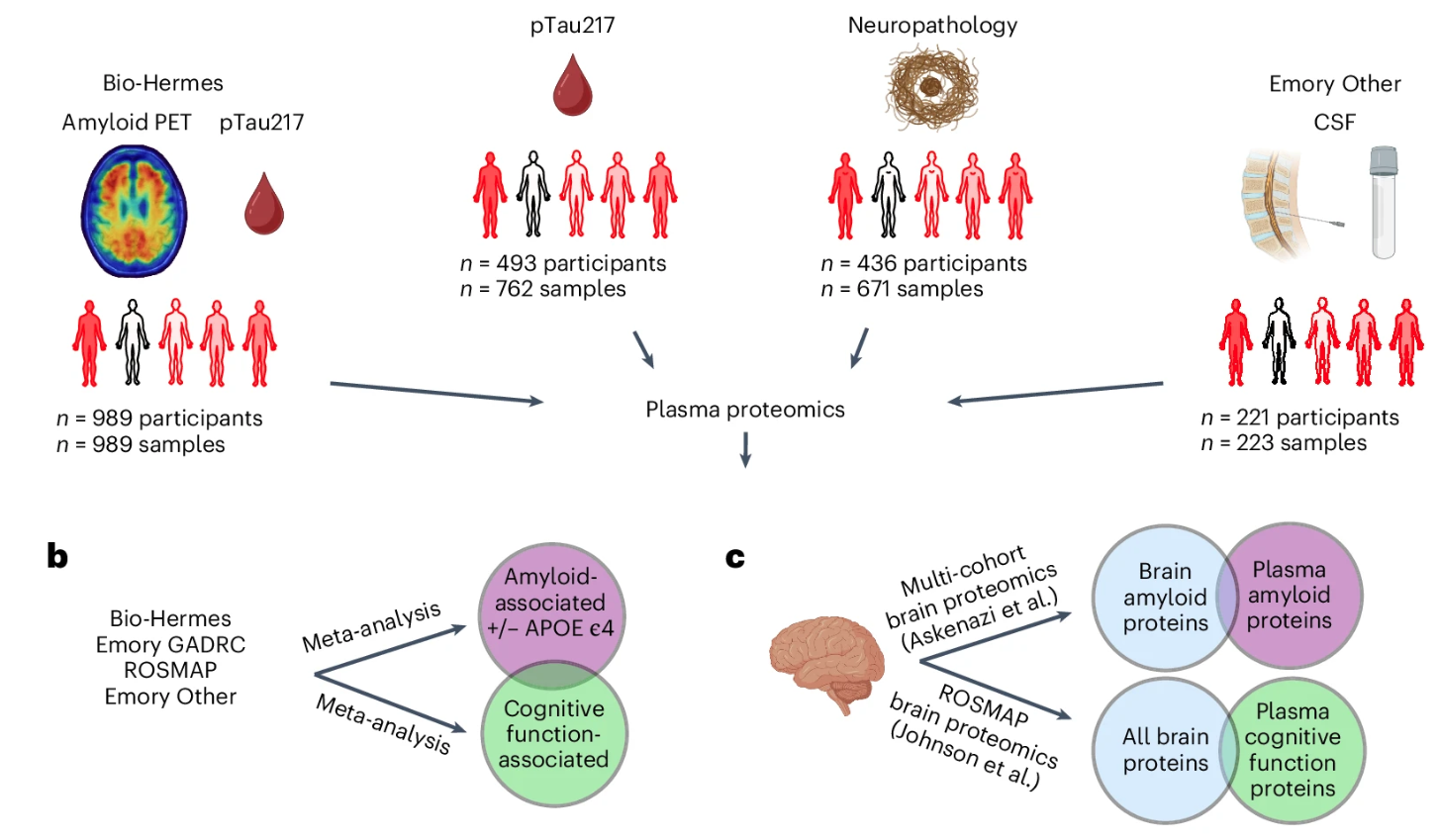
Study design
02 Large-scale plasma proteomics
reveals diagnostic biomarkers and pathways for AD
Paper: Large-scale plasma proteomic profiling unveils diagnostic biomarkers and pathways for Alzheimer’s disease
Journal: Nature Aging
Impact factor: 19.4
Key findings:
● Using a three-stage design (discovery, replication and meta-analysis), the study identified 416 AD-related plasma proteins in 3,366 participants, 294 of them newly discovered.
● A machine learning model built on seven proteins showed high predictive performance for clinically defined AD and biomarker-defined AD status (AUC > 0.88).
● The findings involve key pathways such as lipid metabolism, immunity, the extracellular matrix and neuronal activity, and were validated across multiple cohorts and platforms.
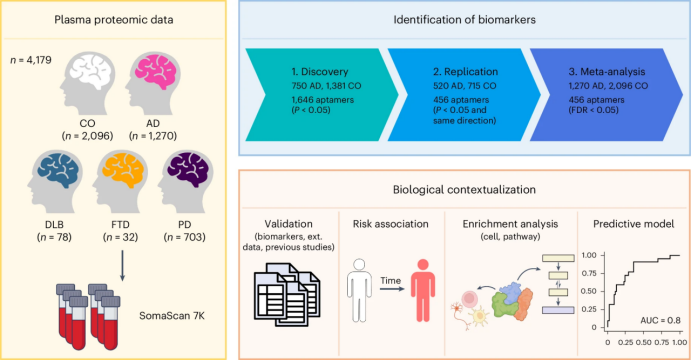
Study design and analytical strategy
03 Plasma proteomics
for differential diagnosis of three neurodegenerative diseases
Paper:
Shared and disease-specific pathways in frontotemporal dementia and Alzheimer’s and Parkinson’s diseases
Journal: Nature Medicine
Impact factor: 50.0
Key findings:
● Proteomic profiling (SomaScan 7K platform) of 10,527 plasma samples from 23 research centers, covering AD, PD, FTD and controls.
● The study identified 5,187 AD-associated, 3,748 PD-associated and 2,380 FTD-associated proteins.
● The proteomes of PD and FTD overlapped most strongly (r² = 0.44), while AD and PD differed most markedly (r² = 0.04).
● Protein-based prediction models distinguished patients from controls with AUCs of 0.81 for AD, 0.83 for PD and 0.88 for FTD.
● The study revealed shared pathways of immune activation and glycolytic dysregulation, as well as disease-specific mechanisms (for example, apoptosis-related proteins in AD and ubiquitin–proteasome system proteins in PD).
● It provides an important molecular basis for early screening, non-invasive differential diagnosis and targeted therapy in neurodegenerative diseases.
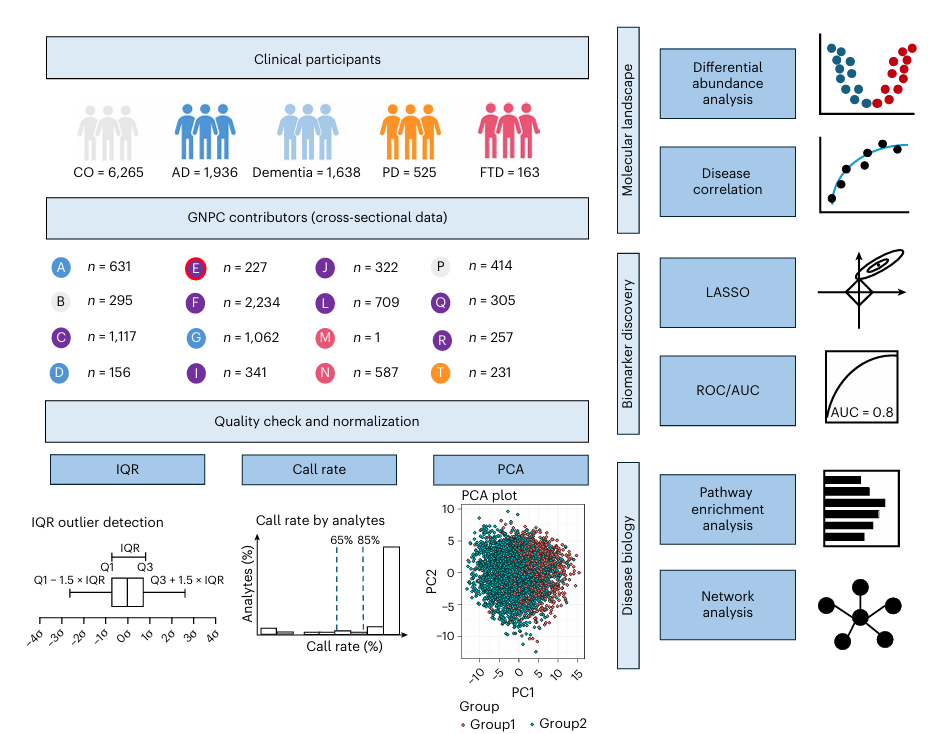
Study design and analytical strategy
Research on plasma proteins continues to advance. Proteins such as p-Tau 217 have already shown clinical potential, lighting the way toward assay kits for early AD diagnosis. Looking ahead, non-invasive tests based on body fluid proteins may allow us to capture faint disease signals before cognitive symptoms emerge, buying patients precious time for early intervention.
