
As gene sequencing and imaging gradually approach the limits of what they can do in predicting recurrence of early-stage lung cancer, a new window is being opened by functional proteomics—one that makes the hidden risk of "clearly early-stage, yet ultimately recurrent" visible for the first time.

In the post-operative management of stage I lung cancer, clinical practice has long relied on morphological staging, imaging follow-up and genetic analysis. Yet a subset of patients always remains in a "gray zone" of assessment—conventional indicators look favorable, but progression still occurs after surgery. This tells us that more critical biological differences must exist that have not been captured. And those differences lie deep within the functional state of tumor cells.
Functional proteomics is precisely the scientific tool for studying and quantifying that state.

1Why focus on proteins rather than genes?
This is a fundamental shift in perspective:
● Genes (DNA):the blueprint of life; they determine "what may be" and are relatively stable.
● Messenger RNA:the construction instruction; it flows dynamically, but the instruction is not necessarily fully executed.
● Proteins:the workers and machines that the cell ultimately runs on; they directly determine "what is being done" and "what can be done."
In lung cancer recurrence, the crucial question is not whether the tumor carries mutations, but whether those mutations have been converted into highly active "dangerous tools."
By analogy: the risk posed by a factory (the cell) does not lie in whether the design drawings (genes) contain errors, but in whether dangerous machinery (proteins) is being produced in quantity and running at high speed. Functional proteomics means walking into the factory floor and directly measuring how those machines are operating.

2How can functional proteomics "see" hidden risk?
Using advanced technologies such as high-resolution mass spectrometry (LC-MS/MS), functional proteomics can systematically and quantitatively analyze proteins in tumor tissue, focusing on:
● Absolute quantification:not only "is it present," but precisely "how much is there"—for key proteins that drive unlimited proliferation, their concentration is directly linked to the speed of recurrence.
● Extraction of multi-dimensional functional features:by measuring multiple functional proteins strongly associated with recurrence at the same time, it captures the tumor's "true activity level" in key biological processes such as proliferation, invasion and immune evasion.
● Algorithmic model integration:using deep learning and machine learning models to integrate quantitative data on 15 functional proteins, identify complex risk patterns, and output a stable, reproducible recurrence risk score with greater predictive power than any single indicator.
In the end, a unique "protein functional activity map" is drawn for each stage I patient, presenting the potential for recurrence in a directly visual way.

3PT-L1™: translating frontier science into a clinical decision tool
Built on these deep insights from functional proteomics,PT-L1™ (a system for predicting the risk of recurrence after surgery for stage I non-small cell lung cancer) was developed. It is not a simple application of technology; it completes the critical translation from research to clinical practice:
● Precise target selection:
By analyzing a large number of clinical samples, the research team did not search blindly; instead, it precisely identified the 15 functional proteins most central and most relevant to recurrence in stage I lung cancer. These proteins cover key biological processes including proliferation, invasion, immune evasion and metabolism.
● Absolute quantification and algorithmic integration:
A high-resolution mass spectrometry platform performs simultaneous quantification, and the algorithm outputs an objective recurrence risk score.
● A closed loop for clinical decisions
High risk: indicates a strong tendency toward recurrence, suggesting shorter follow-up intervals and earlier intervention.
Low risk: indicates a low probability of recurrence, allowing fewer intensive examinations and less burden on the patient.
4Advantages over conventional approaches
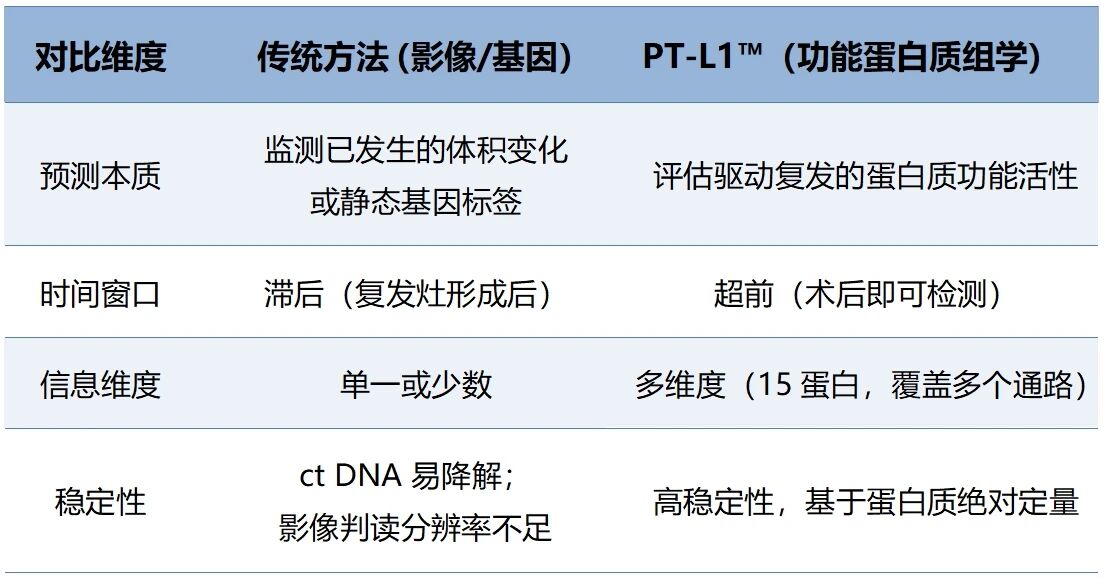
5From "same disease, same treatment" to "same disease, different treatment"
Functional proteomics is not merely a new technology—it is an innovation in the management paradigm. Two patients with the same stage may follow entirely different management paths because their protein functional profiles differ.
This is the very core of precision medicine:designing strategy according to individual biological characteristics rather than anatomical appearance.
Tumor recurrence originates from an imbalance in protein function. Functional proteomics gives us the ability to measure that imbalance directly. PT-L1™ is turning scientific understanding into clinical practice, giving every stage I lung cancer patient a more precise and more reassuring management plan.
The sooner we understand the tumor's "functional face," the better we can take the initiative against recurrence. This migration of perspective—from "genes and imaging" to "protein function"—is redefining the standard of care for early-stage lung cancer.
