
Many people share the same confusion:
"I've been really careful about my diet — hardly any oil, hardly any meat,
but my blood lipids are still high, even higher than last year."
This is not an isolated case, and it does not mean you lack self-discipline. Blood lipid problems are, at their core, more complicated than simply how much you eat.

! Eating Less Fat ≠ Blood Lipids Will Necessarily Improve
In the public mind, abnormal blood lipids are often treated as simply "a disease you eat your way into." The solution therefore seems equally direct:
High blood lipids → too much oil → just eat less.
Medical research, however, tells us this logic is only half right. Blood lipids are shaped not only by how much you take in, but — more importantly — by whether the body's lipid metabolism and regulatory systems are working properly.
Most of the cholesterol in your body
does not actually come from food Fact One
Many people are surprised the first time they hear this: under normal circumstances,roughly 70% or more of the cholesterol in human blood comes from endogenous synthesis in the liver, while the share that comes directly from the diet is comparatively small.
In other words, even if you consume not a drop of oil, your liver will still synthesize cholesterol along its established metabolic pathways to meet basic needs such as cell structure and hormone production.
And once those metabolic pathways go wrong, blood lipids can spiral out of control.
Abnormal blood lipids are
usually a problem of the "metabolic system" Fact Two
From a clinical and metabolic perspective, blood lipid levels are shaped by multiple pathways acting together, including:
● Whether hepatic lipid synthesis and clearance are balanced
● The efficiency of lipoprotein transport, conversion and recycling
● Whether insulin resistance or metabolic syndrome is present
● The influence of genetic factors on lipid metabolism pathways
That is why, on equally light diets, some people keep their lipids stable while others never manage to bring them down.The issue is not whether you eat "little enough," but how your body actually handles lipids.
Going extremely low in fat can backfire Fact Three
There is one more easily overlooked phenomenon: long-term, extremely low-fat and low-energy diets are not necessarily friendly to your blood lipids.
When the body remains in an energy-deficient state over time, it may activate compensatory mechanisms:
● Increasing endogenous lipid synthesis in the liver
● Altering the way fatty acids are utilized
● Affecting the balance between triglyceride and cholesterol metabolism
The result: eating less does not necessarily mean being healthier — and blood lipids can become even harder to control.
! Meeting lipid targets does not mean the risk has disappeared
A conventional lipid panel in a routine check-up usually covers four basic indicators: total cholesterol (TC), low-density lipoprotein cholesterol (LDL-C), high-density lipoprotein cholesterol (HDL-C) and triglycerides (TG).
These indicators matter, but what truly determines cardiovascular and cerebrovascular risk often lies elsewhere:
● Which lipoprotein particles the lipids are carried in
● Whether particle number, size and subfractions are abnormal
● Whether the metabolic system as a whole is disturbed
That is why this situation is so common: LDL-C has reached its target and lifestyle changes are under way, yet the risk is still there.

LipidVoyage™: Helping You See the Whole Picture of Your Blood Lipids
Built on NMR (nuclear magnetic resonance) spectroscopy, LipidVoyage™ needs only one tube of blood to deliver a full-spectrum lipid assessment:
● Comprehensive measurement of lipid components
● Quantification of lipoprotein particles and their subfractions
● Risk stratification and early warning
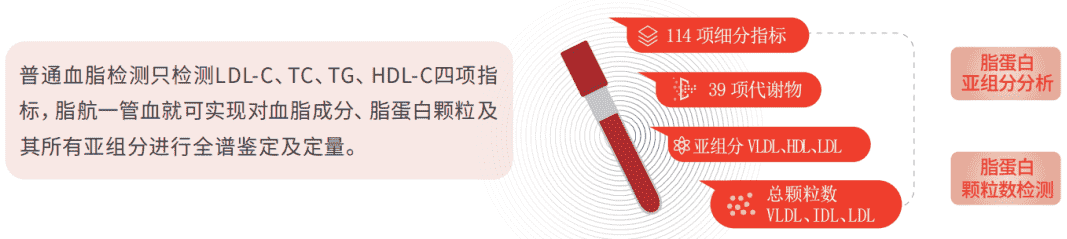
Put simply, it brings to light the risks that the conventional "four numbers" cannot show. It gives you a clearer sense of direction when lowering lipids, adjusting your lifestyle or monitoring over the long term, rather than groping in the dark.
Understanding dyslipidemia means looking at the system, not just staring at the numbers:
● Early risk identification → Knowing your potential problems before conventional lipid abnormalities appear
● Precise intervention → Using full-spectrum results to guide lifestyle adjustment or treatment choices
● Long-term monitoring → Enabling high-risk individuals to track lipid changes dynamically
● Residual risk assessment → Identifying metabolic abnormality risk even after LDL-C targets are met
When your diet is already restrained enough and still cannot explain the changes in your blood lipids, the problem usually lies not in willpower but in whether we have truly seen the metabolic structure behind those lipids.
Managing blood lipids calls for more complete information, not more extreme restrictions.
